|
Experiment Table CD4+ T lymphocyte counts and viral RNA
Neutralizing Antibody Assays
Peptide-binding Assays
|
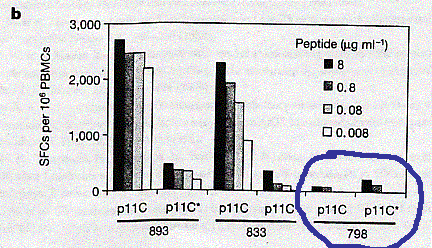
In the ELISPOT Assay cells are placed in wells and exposed to antigens to test their response. The researchers were able to easily measure the response of a subjects T lymphocytes to a p11C antigens with this ELISPOT Assay.....Below is the graph of the spots for each of the subjects when tested against both the wildtype p11C and the p11C* mutant. This graph shows the data collected from ELISPOT assays performed on blood samples collected from monkeys 798, 893, and 833
Look at the graph carefully...do the subjects show a strong response to the mutant peptide? The response against the peptide decreases slightly as the concentration of p11C used to stimulate the T ells decreases. Why is this so?
The mutant p11C peptide was recognized by CD8 T-lymphocytes dramatically less than the wild type p11C peptide in three different monkeys. The immune system in all three cases responded less to the mutant p11C than the original wild type form, indicating that the mutant epitope elicits little to no response form the immune system.
Additionally, monkey 798, the monkey in which the mutation occurred, experienced nearly no recognition of either the mutant or wild type p11C peptides.
The low response to the wild type p11C may have been the result of decreased exposure to this epitope following the complete replacement of the viral population by only quasispecies that contained the p11C mutant genotype.
|