|
Viral Sequencing
Results
Some of the most interesting, and informative
pieces of information came from the study of the changes
in sequence among the SHIV quasispecies in the subject.
By looking at sample segments of genetic material along
the viruses genome the researchers were able to learn
quite a bit about the strategies employed by the virus in
regards to mutations to escape the body.
Why would a mutation in the CD4 protein in SHIV
harm the virus while a mutation in a structural coat
protein help it?
The data given are the amino acid sequences of certain
regions of HIV proteins that have been determined to be
of immunological relevance.

This figure shows the amino acid sequences of specific
epitopes through 44 weeks of analysis. A dashed line
indicates that the sequence is the same as listed at the
top. In the parentheses is the number of clones with the
sequence listed next to it, over the total number of
clones isolated at that time.
Of special note is the mutation that occurred in the
gag p11C epitope. This mutation arose prior to week
twenty and was present in all clones isolated following
that point. Consider the graph below...
Do you think this substitution would more likely
appear in a crucial gene or a nonessential gene of the
virus?

Notice how the substitution in question is absent from
all measured clones the first two times the samples are
taken.
What happens after week 14?
What is the significance that 0 of 23 clones had
the p11C mutation before week twenty, but 53 of 53 clones
taken from monkey 798 after week twenty had the
mutation?
The researchers found that when the protein that is
partially encoded by this segment is tested by comparing
the wildtype (isolated before the substitution was
detected in the population) to the mutant (isolated after
the substitution was detected in the population) the
affinity of the mutant for the MHC (which binds epitopes
to display to T cells) dropped 100 fold and recognition
by CD8 T cells dropped 1000 fold.
In light of this new information is the possibility
that the substitution is linked to increased fitness for
the virus, strengthened, weakened, or unchanged?
But the story doesn't end here yet...the researchers
looked into changes among 5 other epitopes. Taking a
closer look at other parts of our graph...
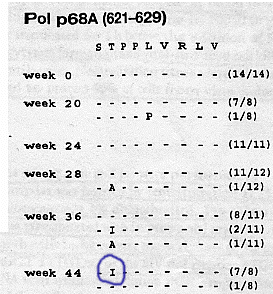
We see that another p11C epitope...Pol p68A, suddenly
displays an isoleucine substitution in most of it's
clones after spending weeks of random drift.
What does this late substitution tell you
about the progression of the SHIV and by extension of
HIV?
|