-
| 
-
| 
-
|
-
| 
-
| 
-
|
-
| 
-
| 
-
|
-
| 
-
| 
-
|
-
| 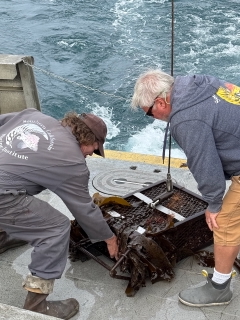
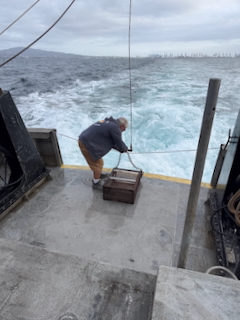
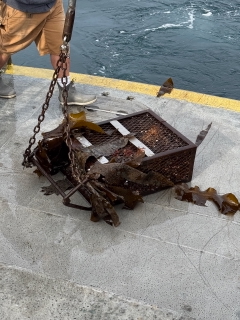
biological dredge at about 22-28 m depth
| 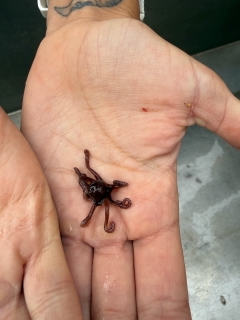
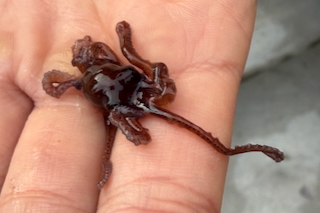
juvenile Octopus rubescens (red octopus)
|
-
| 
-
| 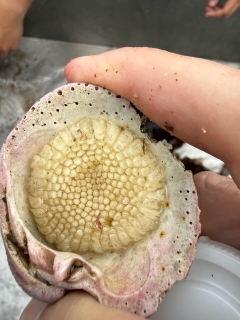
This egg mass is from Crossata californica (California frog snail), which lays its spiral set
of egg cases
in a half bivalve shell like this clam shell. Occasionally, it will use a non-clam bivalve such as a scallop.
In this case, the mother snail that would normally be brooding the egg cases was likely detached during the dredge.
Each of many tiny embryos (visible inside egg cases) would normally hatch as similarly tiny veliger larvae, which are likely planktotrophic
(feeding and growing while still in the planton), although the larval cycle still needs better confirmation from my own literature research.
In fact, the larval development is even more lacking for other Eastern Pacific species of the same caenogastropod family, Bursidae. In 1938, G. E. MacGinitie estimated (Source 1) that
a female C. californica he observed had laid about 822,000 eggs, over four times as many eggs as his estimate for counted embryos in a mass of egg cases laid by a female neogastropod,
Kelletia kelletii (Kellet's whelk).
He found this contrast contrary to his expectations because, of these two species, only the females of C. californica brood their embryos. However,
bursid snails and the superfamily to which they belongs, Tonnoidea, do tend to have conserved egg mass appearance similar to this frog snail, and Atlantic and species from other regions generally do release
tiny larvae that are soon capable of plantotrophic development, with extremely lengthy duration and considerable growth from feeding in the plankton. In contrast, neogastropods
including K. kelletii (Buccinidae) can have quite yolky embryos inside their
egg capsules. But the full larval life history of K. kelletii was until recently incompletely known. Fortunately, Jann Vendetti recently reared K. kelletii larvae beyond the hatching stage (Source 2).
She found that planktonic larvae reared in the lab relied on the yolk that was still available at hatching
stage, and the lab-raised larvae were unable to feed until about 69 days following fertilization.
It seems that both species are planktotrophs but the Kellet's whelk embryos start out larger with more yolk, so that
helps explain McGinitie's paradox.
(Source 1: McGinitie 1938 - Source 2: Vendetti 2020)
|
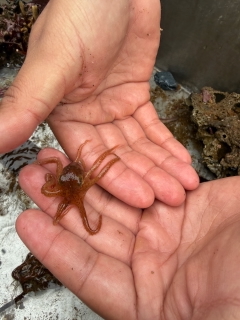
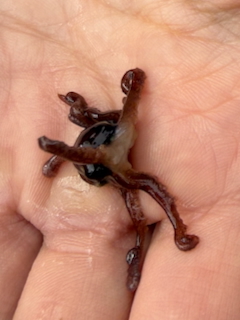
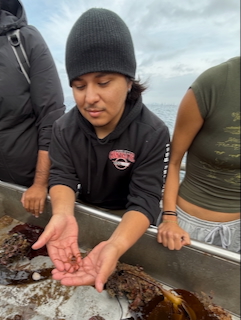
another juvenile Octopus rubescens (red octopus)
| 
-
| 
-
|
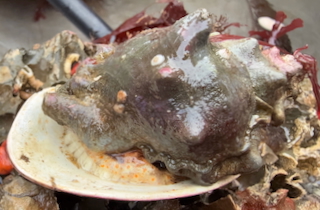
Another (see above) Crossata californica (Californiaifrog snail), this time with the mother
attached, with the orange-spotted foot overlaying the egg cases.
| 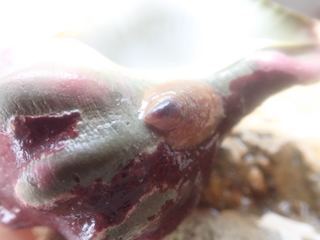
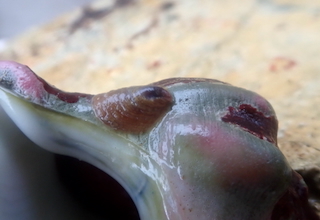
The shell of this Crepidula onyx (onyx slipper snail) has grown to conform to a rib in the shell of
its host, Kelletia kelletii.
| 
-
|
-
| 
-
| 
-
|
-
| 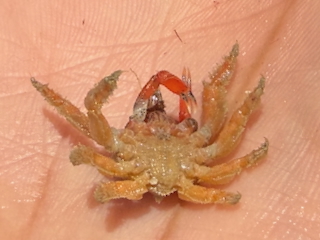
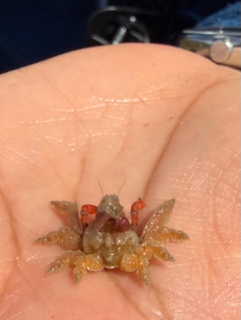
Pelia tumida (dwarf teardrop crab), belongs to the true crab superfamily, Majoidea (spider and decorator crabs),
family Epialtidae, subfamily Pisinae, and is distributed from southern California to northern Baja California, Mexico.
| 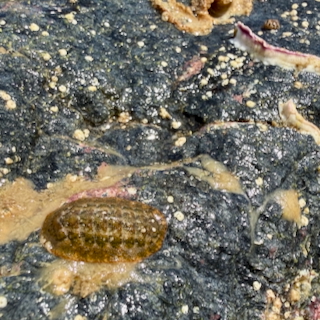
A chiton, Lepidozona pectinulata (pectinate Lepidozona), from the underside of a rock, with some
keeled calcareous tubes of serpulid polychaetes, Spirobranchus spinosus (California Christmas tree worm), in the upper right of the image.
|
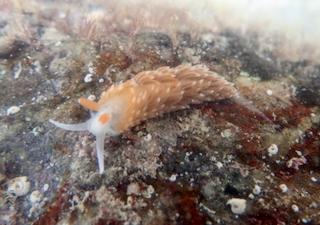
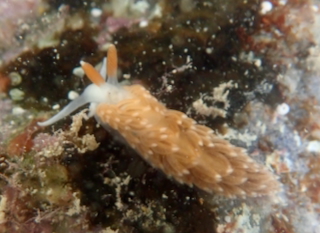
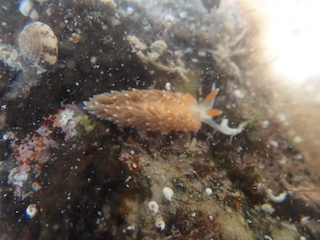
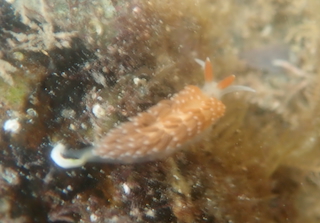
Anteaeolidiella oliviae(Olive's aeolid) is a small nudibranch that feeds on small
anemones.
| 
-
| 
-
|
-
| 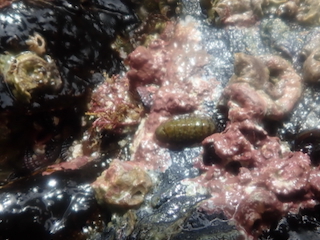
This small chiton, a southern relative of a central California species that I named based on my PhD research,
Cyanoplax caverna (sea cave brooder).
Based on a molecular and reproductive study, I now consider these on Catalina Island to be part of a distinct Channel Islands endemic species that I am in the process of
describing as a new species.
| 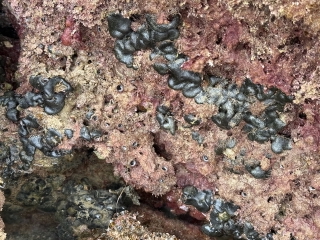
A green alga, Codium setchellii, with a spongy nearly encrusting growth on intertidal rocks.
|
-
| 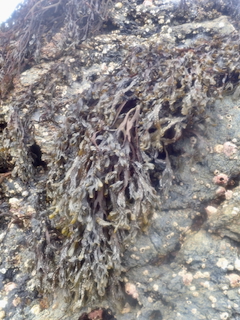
The brown alga rockweed, Pelviopsis californica (formerly Hesperophycus californicus; common name
olive or California rockweed) is fairly rare in the southern California intertidal but is quite common on Catalina Island. We found it occurring higher on rocks than
Silvetia compressa ssp. deliquescens (golden rockweed), a subspecies found primarily on California's Channel Islands, including Catalina. It is smaller
and more delicate than the familiar rockweeds of this species on California's mainland.
| 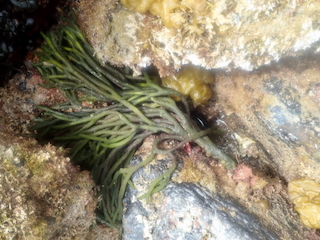
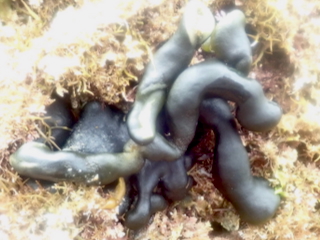
The widespread green alga commonly referred to as Codium fragile (dead man's fingers) is apparently
a complex of multiple similar appearing species, including both native and introduced species in California. They are interesting because they have giant elongate cells
with numerous nuclei. Small and often cryptic sea slugs known as sacoglossans are often found feeding on these nuclei by piercing the cells and slurping up the nuclei.
|
-
| 
-
| 
-
|
-
| 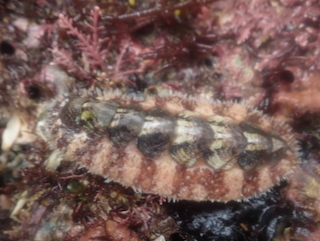
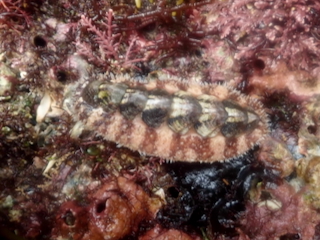
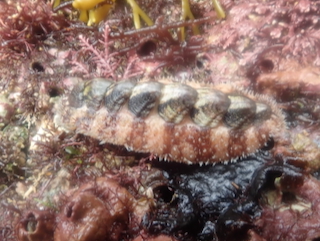
In addition to describing the new chiton species mentioned above, I am also involved with students and others in
describing this chiton that we refer to as Nuttallina n.sp.A.
| 
-
|
-
| 
-
| 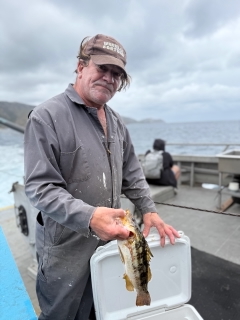
Paralabrax clathratus (calico bass or kelp bass) are not true bass, but members of the sea bass
family, Serranidae.
|
-
| 
-
| 
-
|
 Under Construction!