
Experiment 3 Results:
The investigators ran a Western blot analysis to look for the presence of anti-hFIX in the sera from mice transfected with rAAV-hFIX.
What is a Western analysis?
A Western analysis is a method to detect the expression or presence of a protein. To identify the protein you must hybridize the protein of interest to a corresponding antibody that contains a radiolabel. The radiolabel will provide a tag, (signal) that can be picked up and identified through autoradiography. In performing this study, the probe for the western analysis was purified factor IX protein as the primary antibody, which was transferred to nitrocellulose blots and incubated with diluted serum samples. The secondary antibody was then applied, which was peroxidase-labeled goat, anti-mouse IgG.
What is the advantage to using the double antibody technique?
This technique generally entails the use of a primary antibody that has specificity and will bind to the protein of interest. Then a secondary antibody is applied that is both specific for the primary antibody and contains a fluorescent or radiolabeled tag. The advantage to this is that you are increasing specificity of the assay and creating a stronger signal with less background interference.
Which lanes would you expect to see a dark band representing the protein?
The bands are visible in the following autoradiography, as follows:
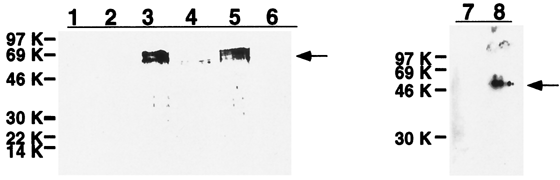
*When viewing the results of the Western analysis it should be noted that the samples were collected at 7 and 10 weeks after rAAV therapy. Serum in lanes 1 through 6 were diluted 1:2,000. In lanes 7 and 8, the serum was diluted 1:1,000. All sera were from mice that received rAAV except lanes 2 and 7. Lane 1 contained secondary antibody only. Lanes 3 and 4 were the hemophilia mice receiving hFIX. Lane 5 was a non-hemophiliac littermate. Lane 6 was a C57B/6 scid control and lane 8, a C57B1/6. Lane 7 was a naïve mouse control.
What is the interpretation of these results?
No endogeneous anti-hFIX antibodies were present in naïve mice whether or not they were treated with normal mouse plasma.
