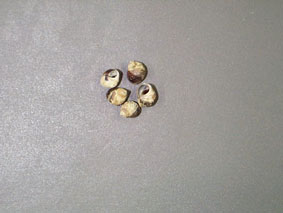
Phylum or Order or Suborder: The Littorines are molluscs and belong to the Order Caenogastropoda. The Classification used here is outlined below:
Members of the Phylum Mollusca are characterized by bilaterally symmetrical (bilateral asymmetry in some) body; unsegmented; often with definite head. The molluscan body is soft and has no regularly organized internal skeleton. The body is neither truly segmented nor surrounded by articulating appendages, such as one finds in insects or crustaceans. Molluscs are particularly distinguished by their soft, flesh mantle, and cape-like organ capable of secreting the calcareous external, or rarely internal, shell. The foot, a broad creeping disc or pointed flexible prong, varies greatly among the various classes of molluscs. Molluscs are also characterized by a unique rasping tongue, the radula, which generally serves in obtaining and breaking up food. Like the arthropods, the molluscs possess a true heart. It is located in the posterior third of the body above or around the rectum, circulating the body fluid through the body. Usually true blood vessels are missing. The blood circulates between the connective tissue spaces of the haemocoel, body cavity. and the body organs. The body cavity are considered separate coelomic structures. The molluscs are one of the major group of true coelomate animals. The nervous system consists of a ganglionlike brain with four main nerve cords running posteriorly from it. Most molluscs exhibit sexual reproduction, many employing copulation. Others expel the sex products directly into the sea where the sperm find the enter the egg. Molluscs belong to the protostome branch and have spiral cleavage and determinate development. All the organ systems are present and well developed. The periwinkle belong to the Class of Gastropoda, one of the five Classes assigned to the Mollusca.
The Gastropoda possess a muscular foot for creeping or burrowing. The organisms that belong to class Gastropoda usually have a distinct cephalic region. The visceral mass is asymmetrical and spirally coiled, and there is a univalve shell which can demonstrate all stages of reduction and can also elongated. Adults may range in size from 1mm the over 60 cm. The foot is flat and usually elongated in a tail like manner. It may be groadened inot flaplike projections. The alimentary canals of some forms contain a crystalline style. The musculature between the mantle and the foot is usually concentrated as an unpaired spindle muscle on the right side or is reduced. Gastropods are either dioecious or hermaphroditic. Fertilization is usually internal. Snails are found in marine, fresh water, and terrestrial habitats. Within the Gastropoda are the subclasses Prosobranchia, Opisthobranchia, and Pulmonata.
The systematics of the gastropods are base on the differences in the pallial complex. Most scientists differentiate between "fore-gilled snails," "back-gilled snails," and "lung snails." The "fore-gilled snails" (subclass Prosobranchia) usually posses a well developed shell corresponding operculum. The mantle cavity is on the anterior side of the shell. The gills (ctenitia) are in front of the pericardium. The nervous cords are situated laterally and are twisted Periwinkles belong to the Subclass Prosobranchia whose members are characterized by one pair of tentacles. The sexes are usually separate. They are usually dioecious and marine. There are two orders: Archaeogastropoda and Caenogastropoda.
The order Archaeogastropoda contains prosobranches usually possessing two auricles, and occasionally two ctenidia and two nephridia. The ctenidia are bipectinate, with filaments alternationg on two sides of the axis and free at the front end. There is not posbiscis. The nervous system is not concentrated, and the pedal cords are ladder like. The inner layers of shell in the majority of the genera are nacreous. The abalones and limpets belong to this order.
The second order of the Prosobranchia is the Caenogastropoda. They are characterized by a single auricle, ctenidium, and nephridium. The ctenidium has only one row of filaments. The system is usually attached to the roof of the mantle cavity. The nacreous layer of the shell is absent. The gill system that is attached to the roof of thepallial cavity has filaments on only one side. This condition is termed pectinibranch. They have only a single auricle and nephridium.
The animals are rather conspicuous because of its unique locomotory method. The two halves of the foot, divided by a deep longitudinal groove, are raised alternately and pushed forward. The periwinkles belong to the family Littorinidae whose members are characterized by anterior mantle cavity, with the gill lying infront of the heart. rocky cracks niches are particularly favorite places where these animals are closely crowded together. Periwinkle are characterized by a partially reduced ctenidium in addition to a lung like roof of the pallial cavity. In Southern California , two Genera are found within the Littorinidae. These are Littorina Keenae and Littorina scutulata.
Distinguishing Characters of Southern California Littorines
Littorina keenae. Common Name - Large or Flat Periwinkle. Also known as Litttorina planaxis. Their height is about 15mm, and the shell is broad and conical. The shell of the large periwinkle are light grey brownish and the spire has three whorls. The lower inside of the aperture has white flattened band and the shell is often very eroded. The large periwinkle are found on rocky shores in high intertidal zone, often under the large rocks. They are found from Puget Sojund to Baja Californai. The large Periwinkle can withstand exposure to air for up to three months as well as live totally submerged in water. When exposed to air they can secret a mucous which creates a holdfast around the aperture of its shell. This glues the animal to the rock surface and seals it off from excess drying. They feed on the fine film of small algae and diatoms that grow on high intertidal rocks.
Littorina scutulata. Common Name - Checkered or Black Periwinkle. The shells of the black periwinkle are very small in size, about 10mm in height, and are black in color. The shells are smooth, narrow and conical and the spire has four whorls. The shells outer surface is brownish with pale checks. The color of the shell is black to brown often with white markings is a checkerboard pattern. Black periwinkles are abundant in both upper and middle intertidal zones especially in depressions and cracks. They are known form Alaska to Baja California. The black periwinkle feeds on microscopic algae as well as larger algae.