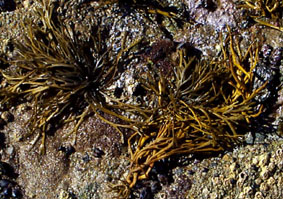
Phylum to order or suborder
Halidrys dioica, Hesperophycus californicus and Pelvetia compressa are brown algae and belong to the Order Fucales. The classification used here is outlined as follows:
Members of the Division Phaeophyta are characterized by having multicellular thalli and a carbohydrate food reserve. Chlorophyll's a and c, fucoxanthin and carotenoids are the pigments found in Phaeophyta. Phaeophyta are often perennial. The Fucoids belong to the class Phaeophyceae the only class assigned to the Phaeophyta. The Phaeophyceae have then, the same general characteristics as the Phylum. The Class Phaeophyceae contains eight order of which the Fucoids belong to the Order Fucales. Fucales are characterized by having parenchymatous thalli that become highly differentiated with maturity. Growth is either apical, intercalary, or diffuse. Reproductive structures (gametangia) are held in concepticles which are embedded in swollen receptacles. The concepticles are also covered with inconspicuous hairs.
Family to Genus
The sea tree belongs to the Family Cystoseiraceae whose members are characterized by bilateral thalli, that become alternately branched. The thalli are differentiated into apical and basal portions. The basal region is perennial while the apical region develops seasonally and is annual in California. The apical region develops during the reproductive season and consists of branches that terminate in reproductive organs and that contain pneumatocysts. The leaf-like basal region when slothed off from the thallus leaves a triangle like scar, due to being attached to an angular stem-like stipe. Solitaire or chains of Pneumatocysts are borne in an intercalary position on upper thallus branches. Conspicuous rows of cells develop in the conceptacle prior to the formation of oogonia and antheridia. Individual antheridia produce up to 64 sperm while the oogonium has one functional egg.
The rockweeds belong to the Family Fucaceae whose members are characterized by thalli which lack a main central axis. Thalli branch in two equal portions above the holdfast; which attaches plants to the substratum. Oogonium produce 1-8 eggs and antheridia produce 64 or 128 sperm. In Southern California, two Genera are found within the Fucaceae. These are: Hesperophycus, and Pelvetia. Members of the Genus Hesperophycus can be distinguished from other Genera within the Fucaceae by the tiny tufts of hair called cryptostomata, that occur in two parallel rows on either side of the longitudinal axis of the thallus or blade. Hesperophycus also have a distinct midrib. Members of the Genus Pelvetia can be distinguished from other Genera within the Fucaceae by having all of it's reproductive structures found in the swollen concepticles. Pelvetia is also characterized by having no midrib. Pelvetia is well adapted to an existence of alternating submersion in sea water and exposure to air.
Pelvetia compressa, formerly called Pelvetia fastigiata (J. Agardh, 1814). Common name - Rockweed. Pelvetia compressa has a yellowish green to yellowish brown coloring. Individual plants can grow as large as 90 cm in frond length. Pelvetia compressa thalli are dichotomously branched with fronds arising from the holdfast. Pelvetia compressa is found on midtidal rocks that are protected from the surf. Pelvetia compressa is scattered along the entire California coast ranging from Mexico to Oregon.
Hesperophycus californicus (Silva), formerly called Hesperophycus harveyanus (Decaisne, 1864). Common name - Rockweed. Hesperophycus has an olive to yellowish brown coloring. Individual plants are approximately 30 cm in length but can get up to 60 cm. Hesperophycus californicus have conspicuous hairs, that lie along either side of the distinct midrib, and are evident when the thallus becomes partially dried during low tides. Hesperophycus californianus is found in the upper mid-intertidal zone where it occurs above Pelvetia compressa where the two species are found together, and is also in abundance from Santa Cruz, California, to Baja California.
Natural History of Southern California Fucoid Algae
Halidrys dioica (Gardner, 1913). Common Name - sea tree. The sea tree has flattened instead of spherical floats. This species is common in low intertidal pools and also occurs in the shallow subtidal on rocks. The color ranges from medium brown to olive. Individuals can reach up to two meters (6.5 feet) in length. Halidrys was once wide-spread; however, it survives today only in California (Los Angeles to Mexican border) and Mexico.
Reproduction
The alga, Fucus, and the related rockweeds, do not produce spores and have an animal-like life history. The mature sporophyte generation has receptacles at the tips containing the conceptacles which contain both male and female reproductive gametes. The eggs (N) in the oogonium are fertilized by the sperm (N) in the antheridium to make a 2N embryo. This then grows into a young sporophyte and then into a mature sporophyte completing the reproductive cycle.
Habitats
The rockweeds are dispersed throughout the rocky intertidal. Hesperophycus californicus is located above Pelvetia compressa in the upper intertidal zone. Pelvetia compressa is located in the midtidal zone in protected rocky shores. Halidrys dioica is found in shallow subtidal waters and in the lower intertidal tide pools.
The Fucoids are located all along the central and southern part of the California coast. More specifically from Santa Cruz to Baja.
Regulating Factors of Population
Fucoids are subject to two major factors that regulate its population. The first is Mother Nature. Extreme changes in temperature, and extreme wind conditions can effect the population. Also, tidal influence can be a factor. Both the absence of tide and the abundance of tide can effect population.
The second major factor is regulating population is human disturbance. People walk on the Fucoids or collect it for food or other purposes, directly effecting the population. However, population is indirectly effected by humans because of pollution. Sewage out-falls and oil-spills can do significant damage to fucoids as well as other organisms.
Predators
Fucoids have many predators. Mollusks, such as chitons, snails and limpets are regular grazers of Fucoids. Also, because Halidrys dioica is found quite low in the intertidal, it is susceptible to fish predation as well as mollusk predation. Another predator of Fucoids is people. People use Fucoids for food and it is also used commercially.
Other Stuff
The ancient Latin name fucus was originally applied to seaweeds in general. In the 1750's, Fucus, Ulva, and Conferva were used as the first generic designations for most of the algae. As currently described, the Fucus still includes some of the most common intertidal plants in the temperate coastal waters of the Northern hemisphere along with a few related genera commonly called rockweeds.
Hesperophycus californicus, formerly called Hesperophycus harveyanus, is easily distinguishable from other rockweeds by having tiny tufts of white hair in two parallel rows on either side of the midrib. Hesperophycus californicus is also endemic to California and is particularly susceptible to oil pollution.
Halidrys dioica, commonly called the sea tree, has been growing along Southern California for a long time. In the Doheny Palisades near San Juan Capistrano and in the other Miocene (13 to 25 million years old) diatomic fossils and siltstone shales of this region, fossils specimens are common and show only minor variation from present-day plants.
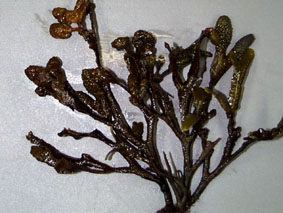
1. Thick perennial basal branches; distinct midrib; annual growth of reproductive structure; upper stipe pinnately branched and feather-like having tapering nematocysts with 5-10 chambers; found in mid low level water (0.0) ... Halidrys dioica
1. Adult plants lacking hollow parts; plants branched...... 2.
2. Tufts of white hair running continuously along both sides of distinct midrib; systematically dichotomous with swollen receptacles sometimes filled with air; olive to dark brown coloring of plants; oogonium containing one egg and one polar body with seven nuclei; located above Pelvetia compressa... Hesperophycus californicus.
2. Dichotomously branched; thick cylindrical stalk; located below Hesperophycus californicus; oogonium containing two eggs; polar body absent with six free floating nuclei; lacking midribs; conical holdfast... Pelvetia compressa.