It can be found from British Columbia to California. It is commonly found on the coast, pilings, boats and has even been found on whales although this is not common. By attaching themselves between mussels they are able withstand some of the wave action. They live in the mid-littoral zone and are exposed to heavy wave action although they do avoid the upper portion of the coast so they do not have to worry about desiccation.
This barnacle is able to catch food by sticking out its legs, called cirri, out into the current to collect plankton. This species is not preyed on is not preyed on by any other animals. The gooseneck barnacle is closely related to the family Lepadidae. This family also has stalked peduncles although the heads of the barnacles is not as elaborate. This species has no economic value.
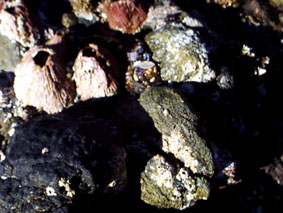
Tetraclita which is common from the Farallon Islands to southern California, is found in the mid-littoral zone. This species of barnacle is exposed to air and desiccation about one half of the day. It protects itself from desiccation by closing up tightly and preventing water loss allowing it to keep the water vapor inside high.
Tetraclita feeds like other barnacles. Its cirri are exposed to the current thus allowing for microplankton to be caught and brought into the barnacle for nutrients. This species is not as abundant on the coast as B. glandula and P. polymerus. This species is in the same family as Balanus, the family Balanidae.
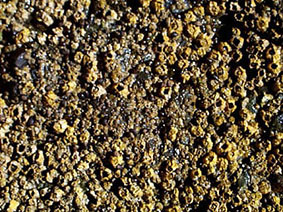
This barnacle lives on the high shores of California to the Aleutian Islands. This barnacle prefers the high mid-littoral zone. There is very little wave action at this point but the barnacles must worry about desiccation. The barnacle is able to close up the plate tightly to prevent water loss during exposed periods.
This barnacles feeds like many other barnacles. Its sticks its legs out of the shell and collect microscopic animals to bring in and feed on. This species is very abundant on the shores of southern California along C. fissus.
References